Does Counter-Attitudinal Information Cause Backlash? Results from Three Large Survey Experiments
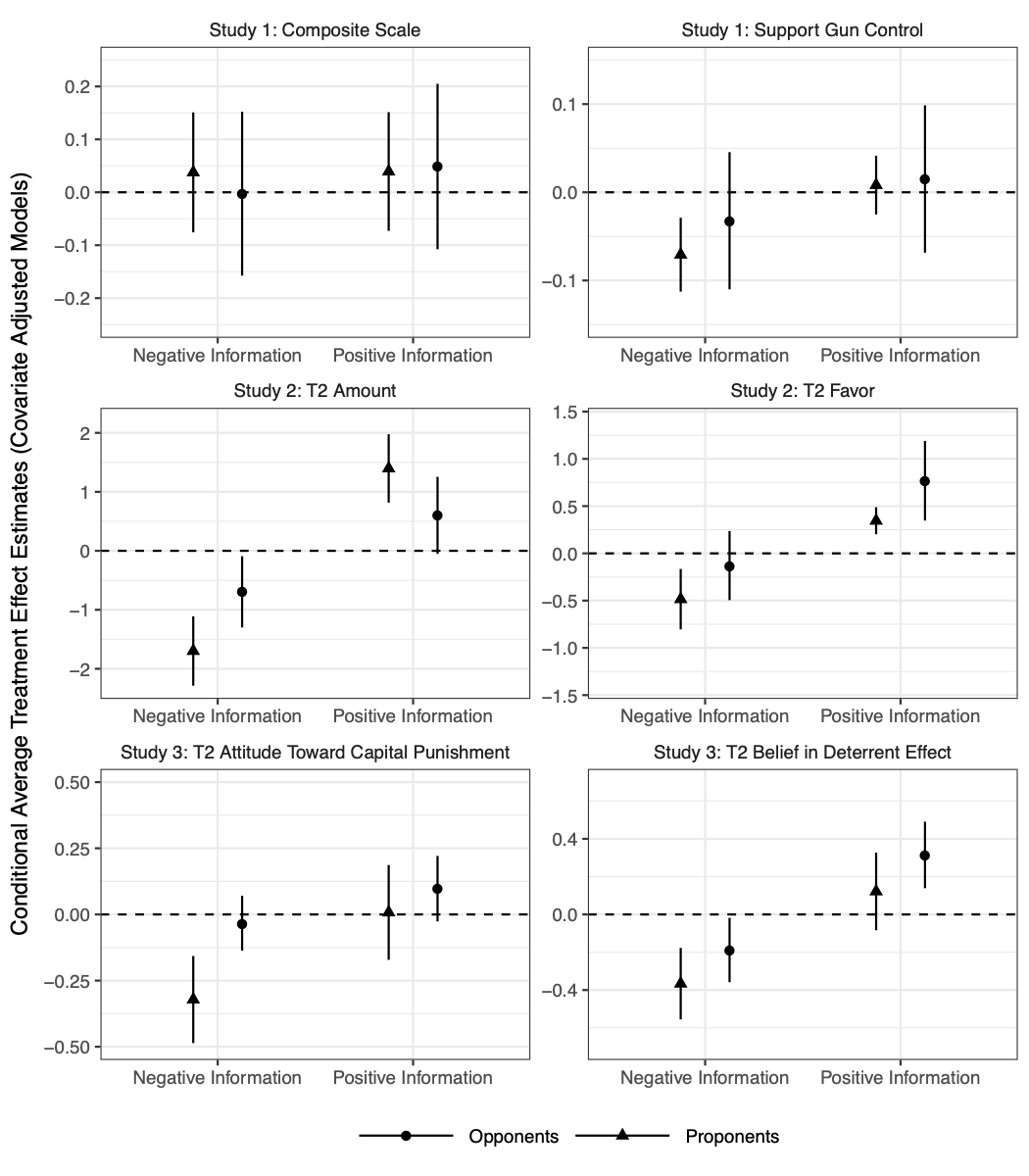
Several theoretical perspectives suggest that when individuals are exposed to counter-attitudinal evidence or arguments, their pre-existing opinions and beliefs are reinforced, resulting in a phenomenon sometimes known as ‘backlash’. This article formalizes the concept of backlash and specifies how it can be measured. It then presents the results from three survey experiments – two on Mechanical Turk and one on a nationally representative sample – that find no evidence of backlash, even under theoretically favorable conditions. While a casual reading of the literature on information processing suggests that backlash is rampant, these results indicate that it is much rarer than commonly supposed.
PDF Appendix Preprint Journal Replication archive Pre-analysis plan 1 Pre-analysis plan 2 Active maintenance Corrigendum Corrigendum in the journal Errata BibTeX
Corrected in 2020. A coding error affected Table 1 of the original article: it made the reported standard deviations of each treatment group, and their standard errors, inaccurate. The corrected table appears in the corrigendum, linked above. No point estimate or substantive conclusion changed.
Guess, Andrew and Alexander Coppock. 2020. Does Counter-Attitudinal Information Cause Backlash? Results from Three Large Survey Experiments: CORRIGENDUM. British Journal of Political Science 50: 1517. doi:10.1017/S0007123419000024