Do Emotional Ads Persuade? Evidence from Real-Time Campaign Advertising Experiments
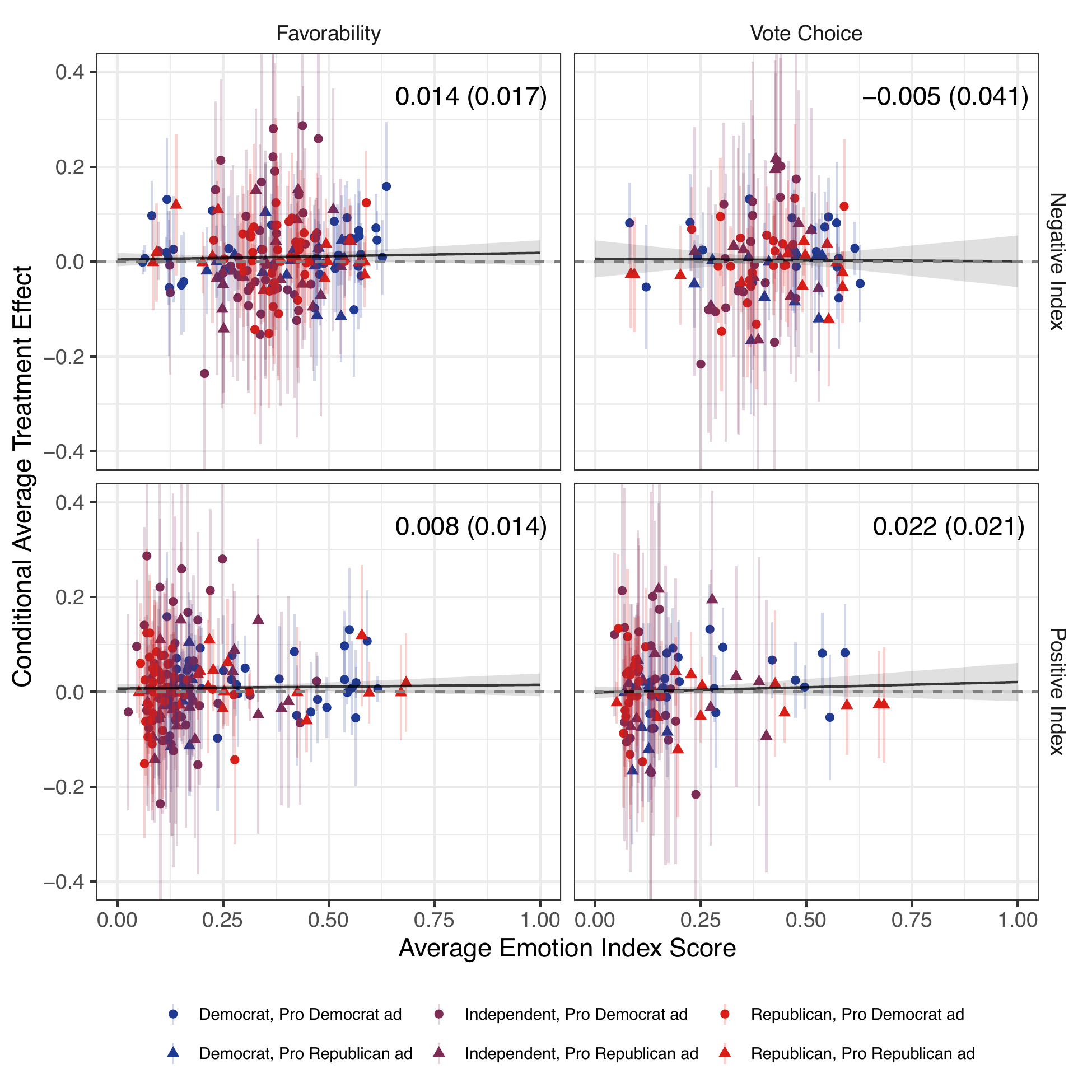
We evaluate whether campaign advertisements that generate larger emotional reactions also generate larger persuasive effects in contemporary elections. We analyze 29 weeks of experiments conducted during the 2016 U.S. presidential campaign, in which 48 authentic campaign ads were tested in real time, often within days of their debut. The ads and a placebo were randomly assigned to approximately 28,000 subjects. We find that campaign ads reliably move emotions, albeit in largely partisan ways, with comparatively muted reactions among independents. Critically, however, these emotional reactions do not predict the magnitude of an ad’s effect on candidate favorability, vote intention, policy preferences, or turnout intention. Our results cast doubt on emotion-based accounts of advertising persuasion in polarized elections and caution practitioners against using self-reported emotional reactions as a measure of message effectiveness.