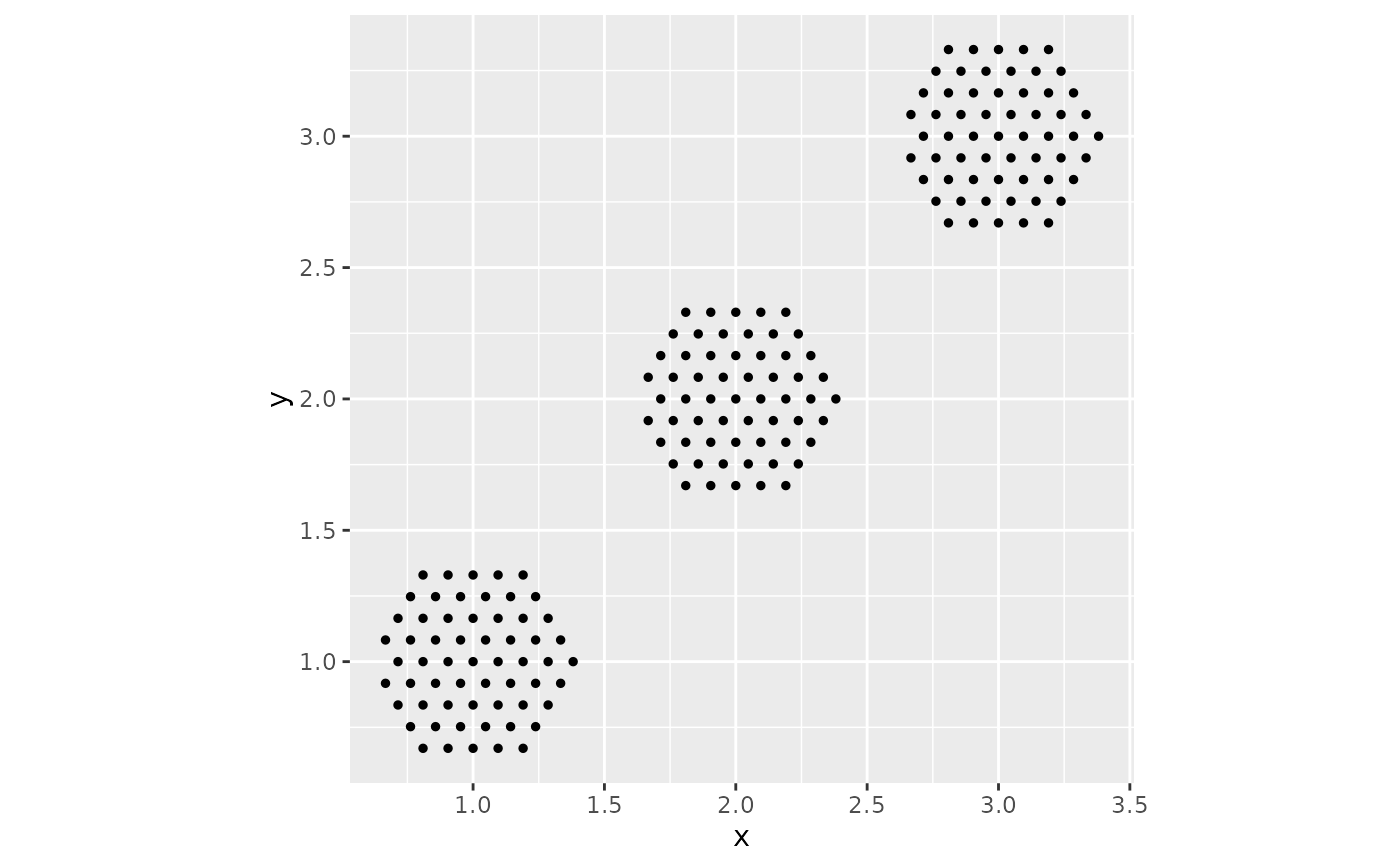
Arrange over-plotted points on a honeycomb lattice
position_honeycomb.RdThis function arranges perfectly over-plotted points on a hexagonal lattice, filling outward from the centre in the order of the data. The hexagonal lattice is the densest packing of equal circles in the plane, so the cluster is as compact as it can be for a given spacing.
Arguments
- density
The pattern density, which defaults to 1 but will have to be adjusted in most cases. The desirable density will depend on both the ranges of the axes and the dimensions of the image.
- aspect_ratio
An aspect ratio adjustment to compensate for distortion of the circular arrangement, which might occur when plotting if coord_equal() is not used. A wide aspect ratio (e.g., 2) would adjust for vertical stretching, whereas a tall aspect ratio (e.g., 0.5) would adjust for horizontal stretching. The default aspect ratio of 1 is appropriate when no adjustment is required. Under coord_fixed(), set
aspect_ratioto the same value as that function'sratioargument.
Details
It is the crystalline sibling of position_sunflower(), which fills the same
footprint at the same density with a spiral rather than a lattice. Choose
between them on looks: the lattice reads as countable and orderly, the spiral
as organic and without a preferred direction.
position_beeswarm() in the 'ggbeeswarm' package also offers a hexagonal
method, and does a different job. A beeswarm spreads points along one axis to
show the shape of a distribution, so perfectly over-plotted points come out as
a line rather than a cluster, and its hexagonal and square methods move points
off their true value on the data axis. Reach for a beeswarm to show a
distribution, and for this to show a count.
Examples
  library(ggplot2)

  dat <- data.frame(
    x = rep(1:3, times = 60),
    y = rep(1:3, times = 60)
  )

  ggplot(dat, aes(x, y)) +
    geom_point(size = 1, position = position_honeycomb(density = 4)) +
    coord_equal()